September 25, 2026 · Easy Arrival Online
Visa, eVisa, ETA, Arrival Card: The Complete Traveler's Glossary
Why this glossary exists
Most travelers only deal with entry document terminology once or twice a year, and every country phrases things slightly differently. By the time you've figured out what one destination requires, the next trip uses different words for what might be a similar process, or the same word for something completely different. This page is meant to be the one you bookmark and come back to, rather than re-learning the vocabulary every time you book a flight.
For a deeper comparison of the three terms travelers mix up most, see eVisa vs ETA vs arrival card: what you need.
Visa
A visa is official permission from a country's government to enter, issued in advance of travel. It can take the form of a sticker or stamp in your physical passport, or increasingly, a digital record tied to your passport number. A visa is required when your nationality doesn't qualify for visa-free entry, or when your trip's purpose or length falls outside what visa-free travel allows.
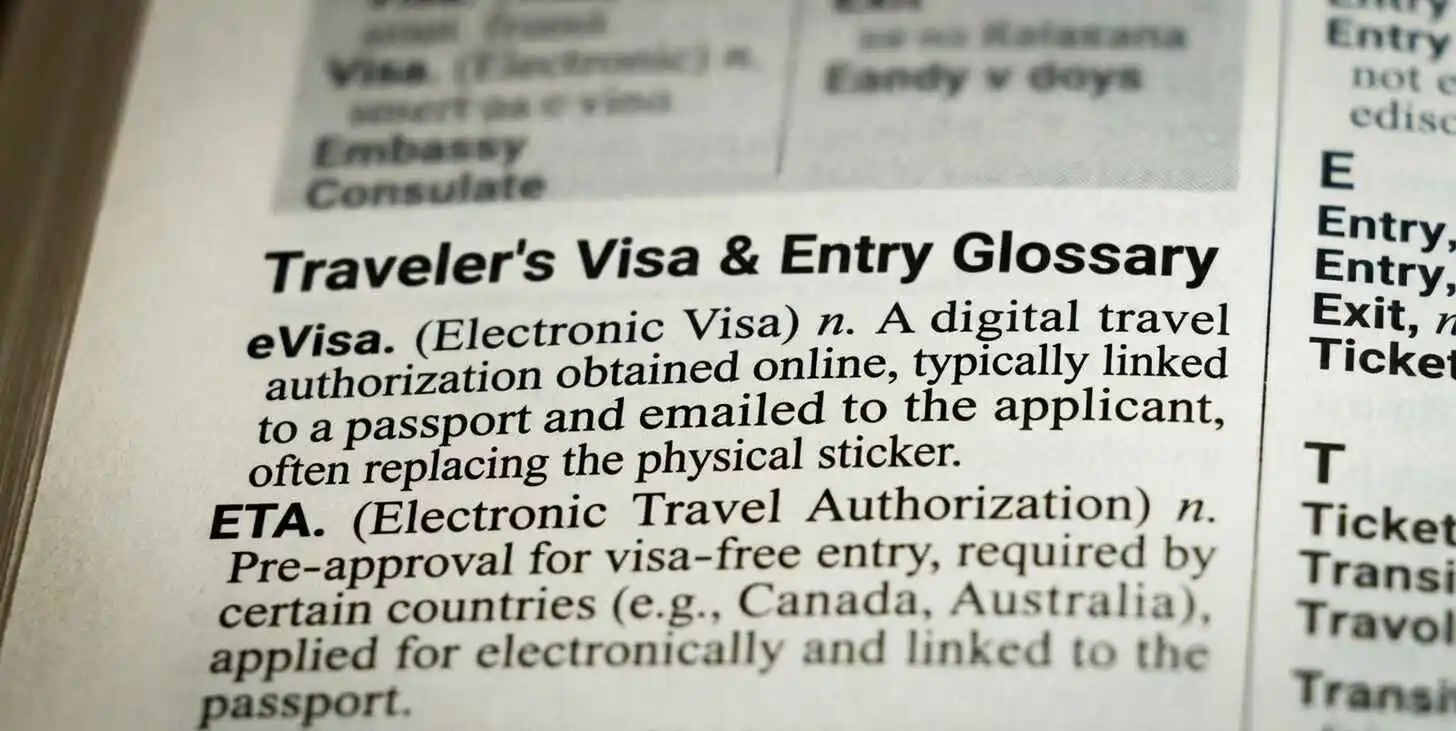
eVisa
An eVisa is the digital version of a traditional visa, applied for and issued entirely online rather than through an embassy or consulate. It still functions as permission to enter, and usually involves some form of review before approval, even if that review is automated. Processing time varies significantly by country and nationality, from same-day to several business days. See India eArrival vs eVisa for a real example of how this plays out.
Visa-exempt entry
This describes a situation where your nationality allows you to enter a country for a limited period, often 30 to 90 days depending on the destination, without applying for any visa at all. Visa-exempt status is tied entirely to your passport's nationality and the specific bilateral agreements in place, so it varies widely from one country to the next and can change without much notice.
Visa-on-arrival
A visa issued at the airport or border itself, rather than in advance. It typically requires a fee paid on the spot and sometimes additional documentation, like proof of onward travel or accommodation. It's being phased out in favor of eVisas and ETAs in a number of countries, so it's worth checking whether it's still available for your destination rather than assuming.
ETA (Electronic Travel Authorization)
An ETA sits between a full visa and visa-exempt entry. It's still a form of pre-approval required before you travel, but it's typically faster and simpler than an eVisa, with less documentation involved. Some countries use an ETA specifically for nationalities that don't need a traditional visa but still require some form of advance clearance.
Arrival card / digital arrival card
A declaration submitted about your arrival, not a permission to enter. An arrival card typically covers your passport details, flight information, accommodation address, and sometimes a customs declaration. It's required in addition to whatever visa, eVisa, ETA, or visa-exempt status already applies to you, not instead of it. Indonesia's IDAC and Thailand's TDAC are both examples of this category. See the Indonesia IDAC guide and the Thailand TDAC guide.
Customs declaration
The section of an entry process, sometimes standalone and sometimes bundled into an arrival card, where you declare goods, currency, or items you're bringing into a country. Leaving this section incomplete or inaccurate is a common cause of extra questioning at the border, covered in 7 common mistakes that get your arrival card rejected.
Immigration
The government authority and physical checkpoint responsible for verifying your right to enter a country, typically the counter you pass through after landing, where your passport, visa status, and any arrival declaration are checked together.
Disembarkation card
An older term, still used in some countries, for what's essentially the paper predecessor to today's digital arrival cards. Some destinations still use a version of this alongside or instead of a digital system, particularly at smaller airports or land border crossings. See paper vs digital arrival cards for where this still applies in 2026.
Onward or return travel proof
Documentation, usually a return or connecting flight ticket, showing that you don't intend to stay in a country indefinitely. Immigration officers in a number of countries can request this even if it isn't formally listed as a requirement, particularly for travelers on one-way tickets.
Submission window
The specific period during which an arrival card or similar declaration can be submitted, typically counted in days before arrival. This window varies by country, and submitting outside of it, too early or too late, is one of the most common avoidable mistakes travelers make. See How far in advance should you submit your arrival card for the exact window by destination.
Assistance service
An independent, paid service that helps travelers complete visa, eVisa, or arrival card submissions correctly and on time. It's distinct from the government itself, and doesn't grant any special approval or speed beyond what the official process allows. See Why use a travel document assistance service for what this actually includes.
A quick way to use this glossary
If you're not sure which of these terms applies to your trip, the fastest way to find out is to check your specific destination and nationality rather than assuming based on a previous trip, since requirements and terminology both vary and change over time.
Frequently asked questions
What's the difference between a visa and an arrival card?
A visa grants permission to enter a country. An arrival card is a declaration submitted about your arrival and doesn't grant permission on its own, it's required in addition to your visa or visa-exempt status.
Is an ETA the same as a visa?
Not quite. An ETA is a lighter, faster form of pre-approval, typically used for nationalities that don't need a full traditional visa but still require some advance clearance.
Do all countries use the same terminology?
No, and that's exactly why this confusion happens so often. The underlying concepts are similar across countries, but the names and specific requirements vary.
Where can I check what applies to my specific trip?
See our full destination list for country-specific requirements.